
Why Your Study Questions Must Come From Your Own Notes
Generic AI can quiz you on anything, which is exactly the problem. On grounding, hallucinated quiz content, and why GapAI rejects questions that drift outside your material.
Key ideas
Two kinds of AI questions
Ask a general chatbot for practice questions about enzyme kinetics and it will oblige, fluently, from everything it absorbed in training. The questions will be plausible, textbook-flavoured, and connected to your actual module only by coincidence.
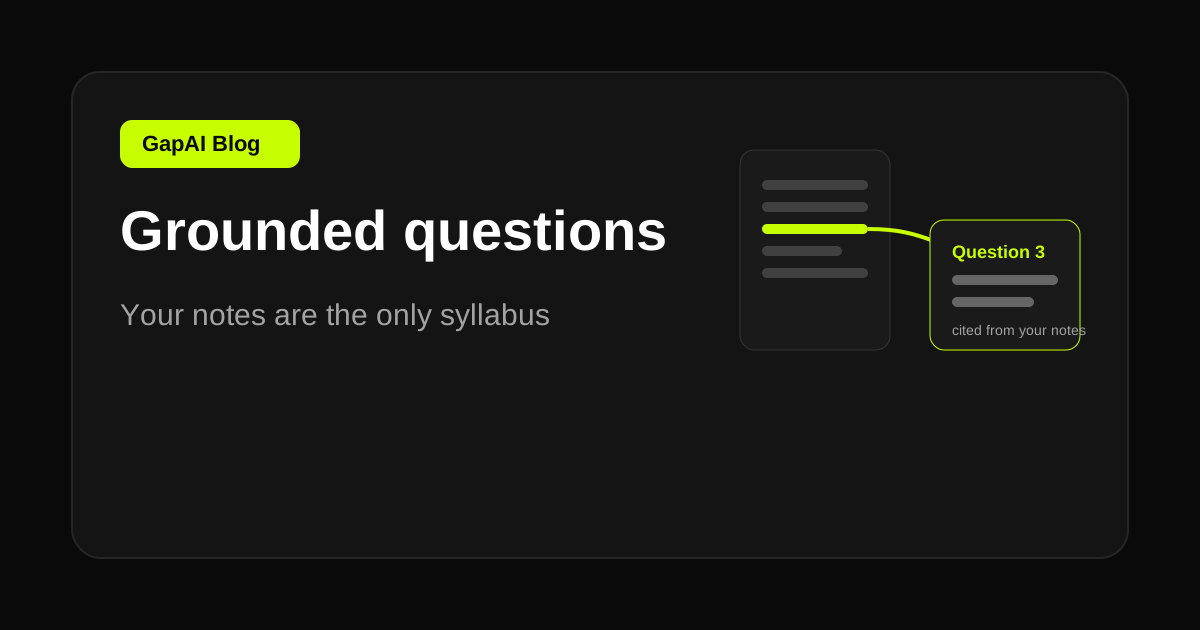
Grounded questions work differently. They are generated from a specific document, your document, and each one can point at the passage it came from. The difference sounds technical. In revision terms it is the difference between practising your syllabus and practising the internet's.
The hallucination problem
Language models generate confident text that is not always anchored to any source, a failure mode the research literature politely calls hallucination. In a chat, a wrong detail is an inconvenience. In revision, it is worse: you may rehearse and remember things your course never taught.
The academic answer to this is retrieval-grounded generation: force the model to work from retrieved source text rather than open-ended memory. That is the architecture GapAI is built on for study content.
What grounding means in GapAI
When you upload material, GapAI first extracts the topics it actually contains and asks you to confirm which ones belong in your plan. Question generation then works inside one topic at a time, from the section of your document that teaches it.
Each generated question must be supported by your text. Questions are checked against the active topic, and ones that drift into a neighbouring topic are excluded before they reach you, and excluded from your mastery score if anything slips through.
Your syllabus is the only syllabus
Exam papers are written from a specific course: this lecturer, these slides, this emphasis. Two textbooks can cover the same topic with different notation, different examples, and different depth. Practice built on the wrong one trains you for an exam you are not sitting.
Grounding also fixes notation. If your slides write time complexity as O(nd), your questions and marking use O(nd). You should never lose marks to an app for using your own course's language.
Honest limits
GapAI is in beta and AI-generated content can still be imperfect. Some questions will occasionally miss, and the marking can misjudge an edge case. The system is built to fail safely: ungrounded questions are filtered, off-topic ones never count toward progression, and wrong ones can be reported in a tap.
Those reports feed directly into making the system stricter. That is the deal of the Early Access Beta: you get free structured practice from your own material, and your feedback sharpens the tool for everyone.